

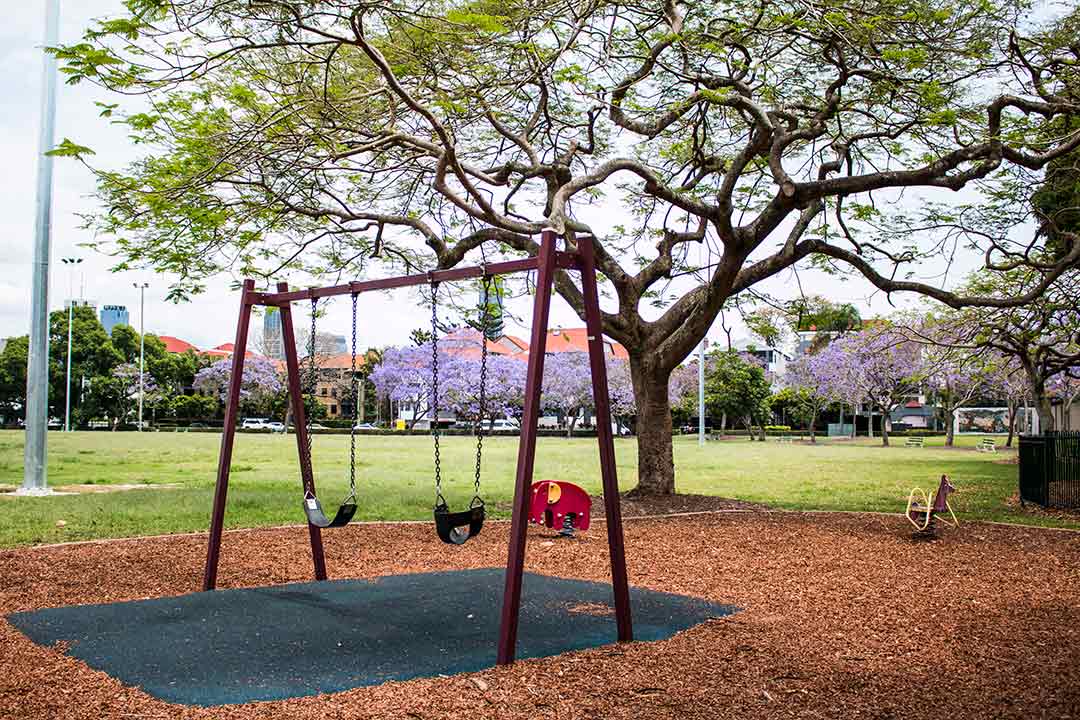
I try to stay informed on online playground news, and this morning, there was an article about the hazards of having trees in the play area. An inspector with the State Department of Children and Families in New Jersey ordered a child care facility to cut the “overgrown vegetation” to a height of two meters on every tree. Either that or a fence would have to be built around each tree to prevent children from getting too close. Failing to do so would put the school’s safety record in jeopardy.
The article said a representative of the department said the request to cut the branches of the trees is based on a requirement in the U.S. Public Playground Safety Handbook, which states that when trees are used for shade, additional maintenance issues arise, such as the need for cleaning debris and trimming limbs. The Public Playground Safety Handbook does not address additional maintenance issues caused by trees, and it does not say that tree branches must be removed to two meters above ground. It simply does not mention trees except to recommend the removal of debris, such as branches that have fallen in the play area, and, of course, branches can fall from any height above the surface, or they can be blown in from trees that are not in or around the play area.
This representative also pointed to the handbook’s section on “suspended hazards,” which states: “Children using a playground may be injured if they run into or trip over suspended components (such as cables, wires, ropes, or other flexible parts).” The Suspended Hazard concern is about flexible components suspended between play units or from the ground to the play unit that are within 45 degrees of horizontal. It does not discuss tripping over suspended components, and it is not about tree branches because tree branches do not suspend from one play component to another. It is about the clothesline effect of running into flexible components like ropes and chains, etc.
There definitely is a concern with trees in a playground, but it is primarily about children using the branches of a tree “Tarzan style” to swing from one play structure to the ground or to another structure. We don’t have structural requirements for branches. We also need to be concerned about running into the ends of branches that might be in the play area, but these concerns are not addressed in the Consumer Product Safety Commission's Public Playground Safety Handbook. There is no specific mention of trees, and there are only two mentions of branches: once as a source of wood chips and once as a type of litter that needs to be removed from the play area.
When we teach the CPSI course on Playground Safety Inspection, we stress the importance of referencing the specific requirements of ASTM or CPRS that the inspector is concerned with when identifying non-compliant issues. This inspector provided specific quotes, but unfortunately, neither of these quotes is from the Handbook. In fact, the Handbook is not even properly identified as a publication of the Department of Consumer Product Safety Commission.
The inspector may have had a valid reason for concern, but apparently did not properly explain the concern and certainly did not quote the source correctly. In fact, the inspector made up the quotes. The department spokesperson and the reporter did not check the facts. They just accepted the inspector’s word.
When an inspector declares something in the play area to be noncompliant, they must give specific and accurate references to the section of CPSC or ASTM that is of concern, and the client and/or customer should be encouraged to challenge the report by looking up the specific reference before any actions are taken.
Irreparable damage to heritage trees and valuable property can be done by such a loose interpretation of guidelines, no matter how well-intentioned.