

Learn how to maximize the safety, durability, and value of engineered wood fiber playground surfacing.
Some playground owners have been finding it increasingly difficult to maintain safe playgrounds due to smaller budgets and fewer maintenance personnel. Others simply need to stretch their financial resources farther to accommodate renovations, additions, new facilities and so on. There are many reasons, but most would say they would like to stretch their financial resources as far as possible.
We all want the most bang for our buck. So, when it comes to playgrounds, and in particular playground surfaces, how do you get the most bang for your buck?
Do you cut corners? Maybe forgo the drainage system or skimp on the base preparation? If the surfacing manufacturer calls for a concrete base, do you go with compacted gravel instead? If the manufacturer calls for a drainage system, do you simply use a layer of weed barrier cloth instead?
Or, instead of specifying an IPEMA-certified surface, do you accept bids for surfaces that have not been third-party certified? Cutting corners is easy and, therefore, is often the first approach taken. But it can have expensive consequences when you consider the fact that a majority of playground injuries result from falls, many of which are falls to the playground surface.
Installing and maintaining a safe surface is arguably your most important safety consideration.
Playground surfacing is not the place to cut corners.
Recommendations
Following the manufacturer’s recommendations is in your best interest. While there are many reasons to do so, let’s look at three of the reasons why. First of all, you retain the manufacturer’s full support in terms of warranty coverage. Second, the test results and product certifications that you received from the manufacturer will be valid and applicable to your site. Third, they make recommendations for a reason, to ensure the product performs as intended.
All too often, playground owners deviate from the manufacturer’s recommendations only to become dissatisfied with the product’s lackluster performance. They might even blame the product, the manufacturer, or maybe that type of product.
Let’s say we chose to stop maintaining our hybrid car. We would experience a short-term savings only to have it let us down in the long run. We might then blame the car, the manufacturer, or hybrid cars in general. The decision we then make would be based on faulty logic and may not be a good decision. Such is the problem with not following the manufacturer’s recommendations.
So, if you don’t cut corners and you do follow the manufacturer’s recommendations, how do you stretch your financial resources?
First, do a life cycle cost analysis to determine the cost of a variety of playground surfaces. Numbers can be adjusted to prove almost any point, usually by someone trying to sell you their product or their services. Ensure that each surface is analyzed on the basis of installation, maintenance, and use according to the manufacturer’s recommendations. From your analysis, using your costs, determine which surfaces will be affordable throughout the entire life cycle.
Warranties
A large park agency in the Washington, D.C. area recently did such an analysis. Engineered wood fiber was the least expensive initially and in the long run, according to their analysis. The more expensive unitary surfaces don’t require maintenance or repairs as frequently. But when they do, it is typically more expensive and requires the use of a certified contractor. And as far as replacement costs, the best warranties on unitary surfaces are about 10 years. You’ll find engineered wood fiber warranties of 15, 20, and even 25 years. Keep in mind that topping off and proper drainage will be required.
You might be thinking that these warranties aren’t realistic. However, some manufacturers can provide test results showing their surface passes at the end of the warranty period. This is something you might want to include in your bid specifications.
But let’s get back to the point. Assuming that unitary surfaces will be cheaper in the long run usually proves to be an illusion. However, unitary surfaces do have their place. For example, if you have the money in your budget for a unitary surface and accessibility is your primary concern, then go with a unitary surface. There is no perfect surface, and theories aren’t reality. To stretch your surfacing dollars as far as possible, consider several different surfaces and do your own life cycle cost analysis.
Next, install products that will reduce your maintenance. You may consider doing a cost-benefit analysis to determine which products will yield the most benefit. You might consider a coating to protect poured-in-place and rubber mat surfaces from premature UV degradation. For artificial grass surfaces, consider using a non-infill grass to reduce repair and replacement costs. Some non-infill grasses can simply be cut and patched or replaced without having to replace the impact attenuating base layer. An infill grass will require new infill, or you’ll have to vacuum up the old infill and reuse it if that is what the manufacturer recommends. It will also be less convenient to keep the infill grass clean, and you might have to rake or top off the infill periodically.
Wear Mats
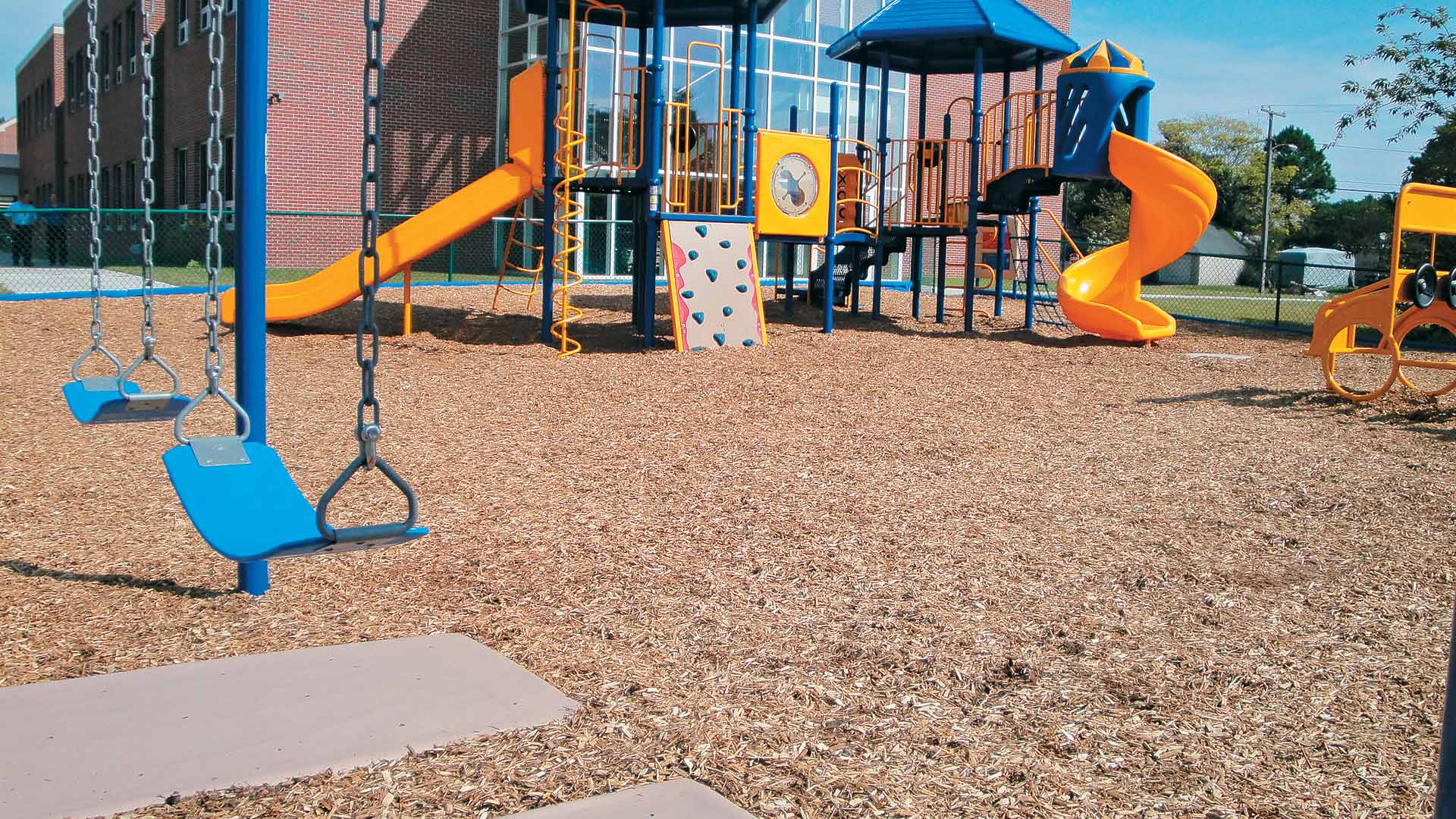
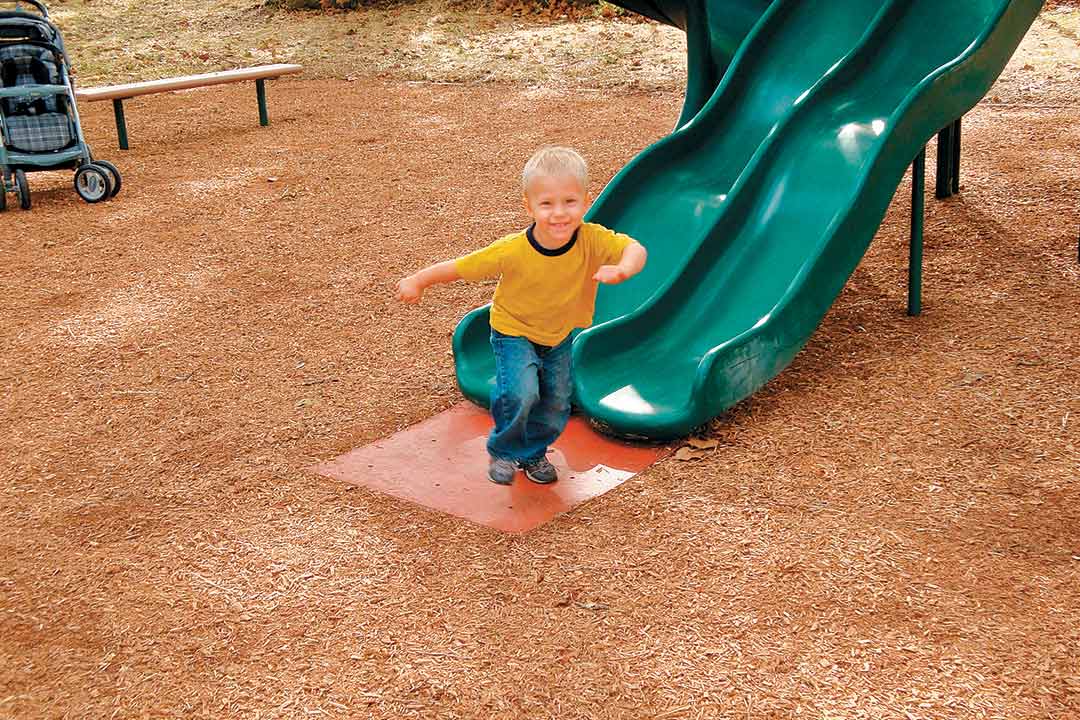
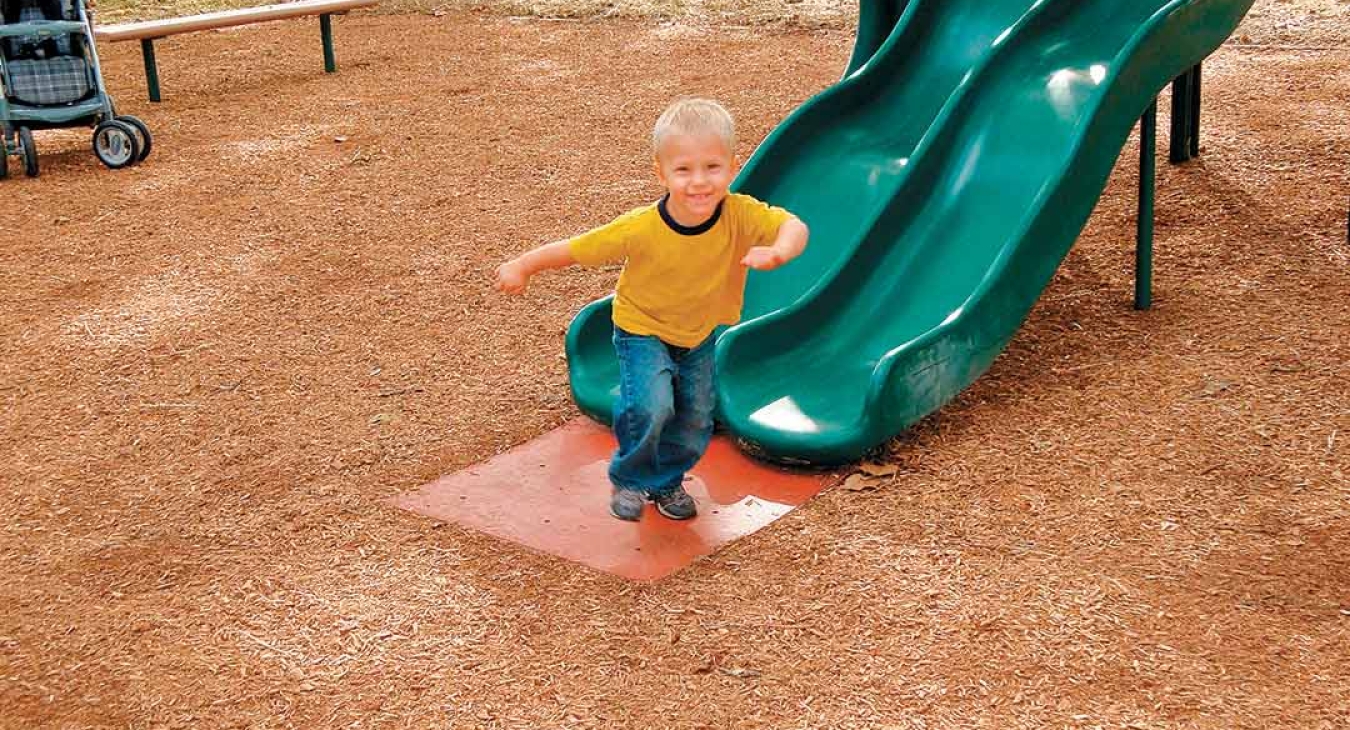
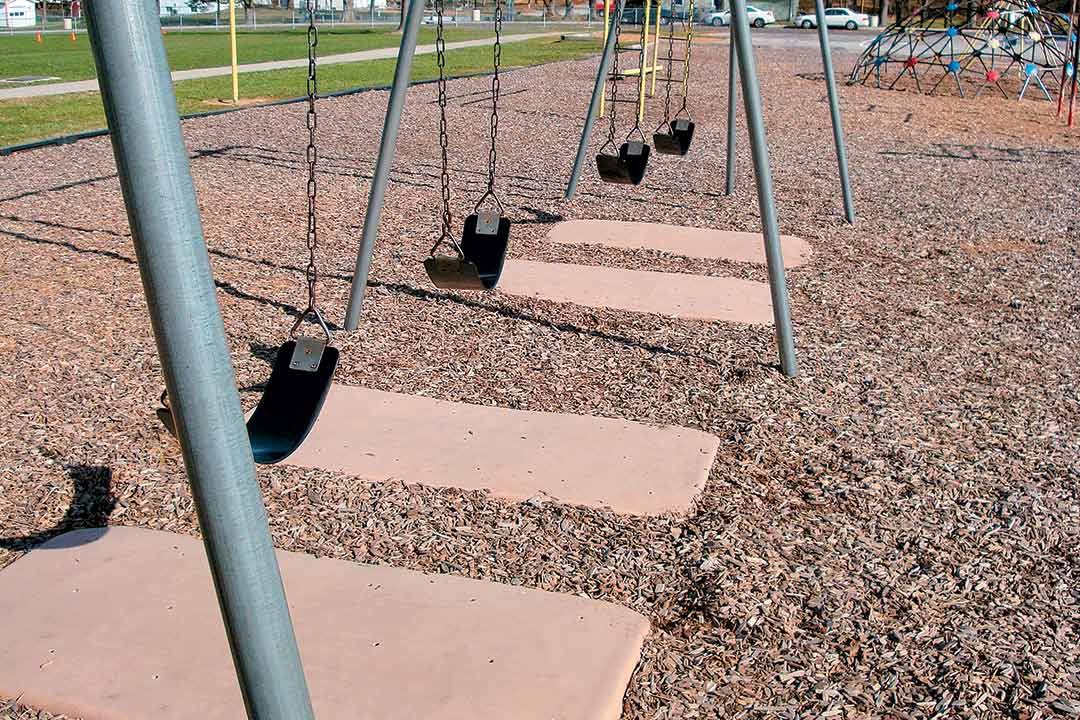
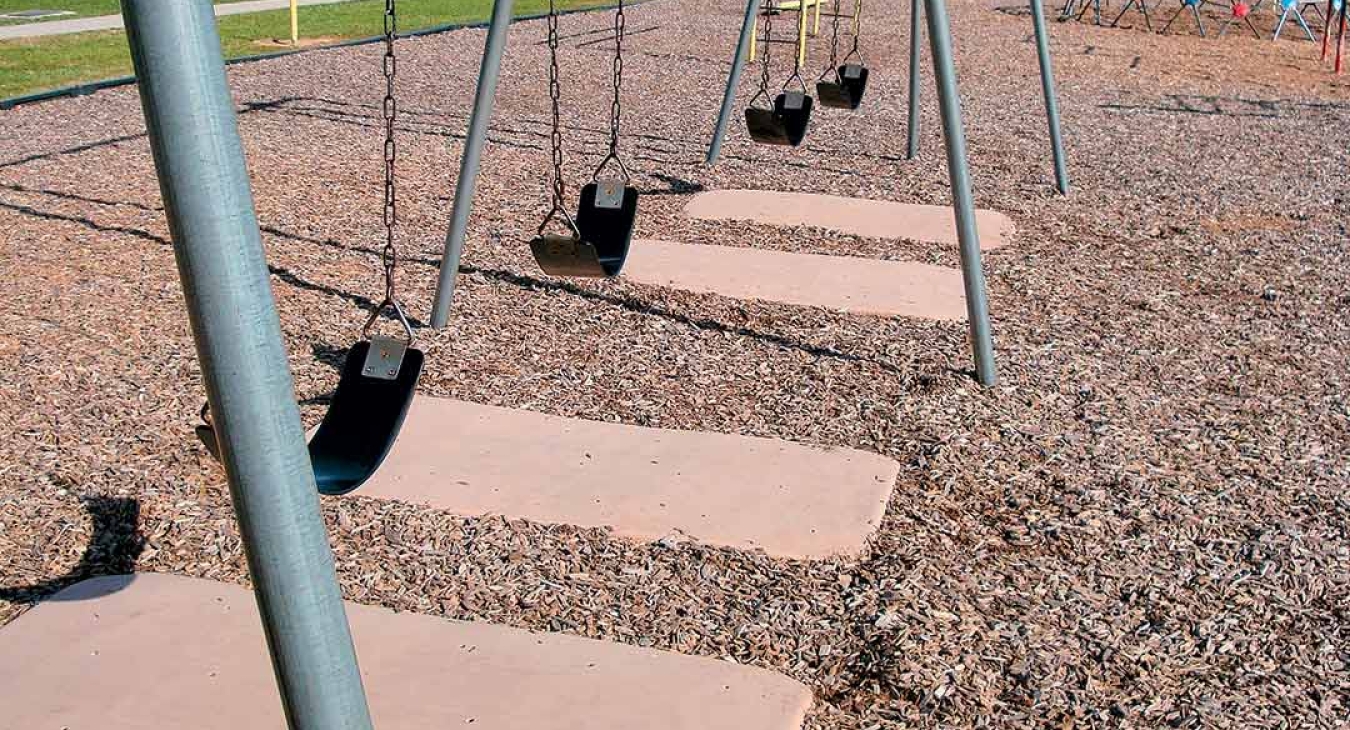
For loose fill surfaces, many are installing wear mats under swings, slide exits, and around spinning playground equipment. It is important to note that the wear mats should be designed for use on top of your loose-fill surface to keep the surface level, which is necessary for proper accessibility. The second reason your wear mat should be designed to stay on top is to maintain the fall protection. A wear mat that is designed to be buried in the middle or at the bottom of the loose fill material will not help you until the loose fill on top of the wear mat gets kicked out. You know that will happen, and when it does, you’ll be left with an uneven surface and only partial fall protection. This is often where you need the accessibility and fall protection the most.
And last, but not least, look for ways to upgrade your playground surface rather than replace it. It is usually much cheaper to upgrade what you have, if possible, rather than to replace it.
For example, there has been a debate for some time regarding the accessibility of loose-fill surfaces. Some are not happy with the accessibility that loose fill surfaces provide, but the alternatives are much more expensive. So, some are installing pathways using unitary surfaces. This eliminates the need to remove and replace the entire surface. One of the least expensive ways to add some pathways to an engineered wood fiber surface is to use a bonded wood fiber surface for your pathways. This will allow you to keep your wood fiber in place and simply bond the top few inches, changing it from a loose fill to a unitary-type surface. Some have even bonded the entire wood fiber surface to provide better accessibility across the entire playground and to reduce the need to rake the surface.
This stabilized or bonded wood fiber solution was the result of the USDA Forest Products Research Laboratory’s work to find an affordable way to improve the accessibility of engineered wood fiber. Their research was made possible by a grant from the U.S. Access Board. At least one manufacturer today offers a stabilized or bonded wood fiber surface.
So, if you are looking for ways to stretch your surfacing dollars, consider a surface with a low life cycle cost, consider products that will reduce your maintenance, and consider upgrading your existing surface. There are a variety of safe and accessible surfaces to choose from. Take the time to talk to other playground owners to find out what they are using and why. Providing a safe playground surface is important, but it doesn’t have to cost a fortune.