

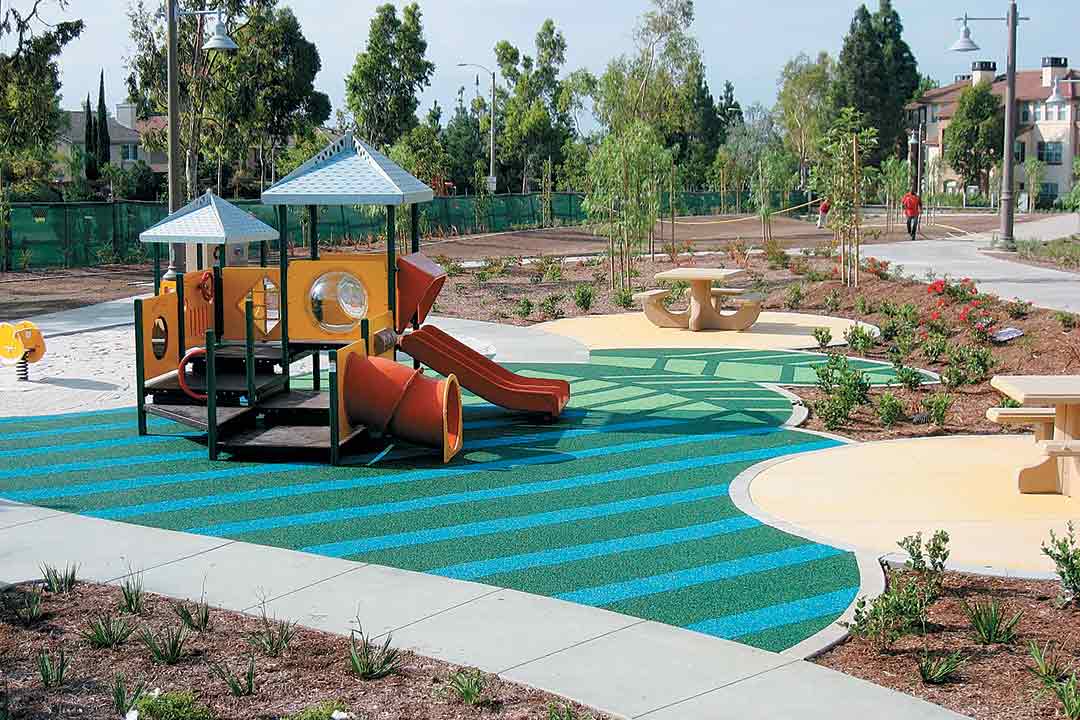
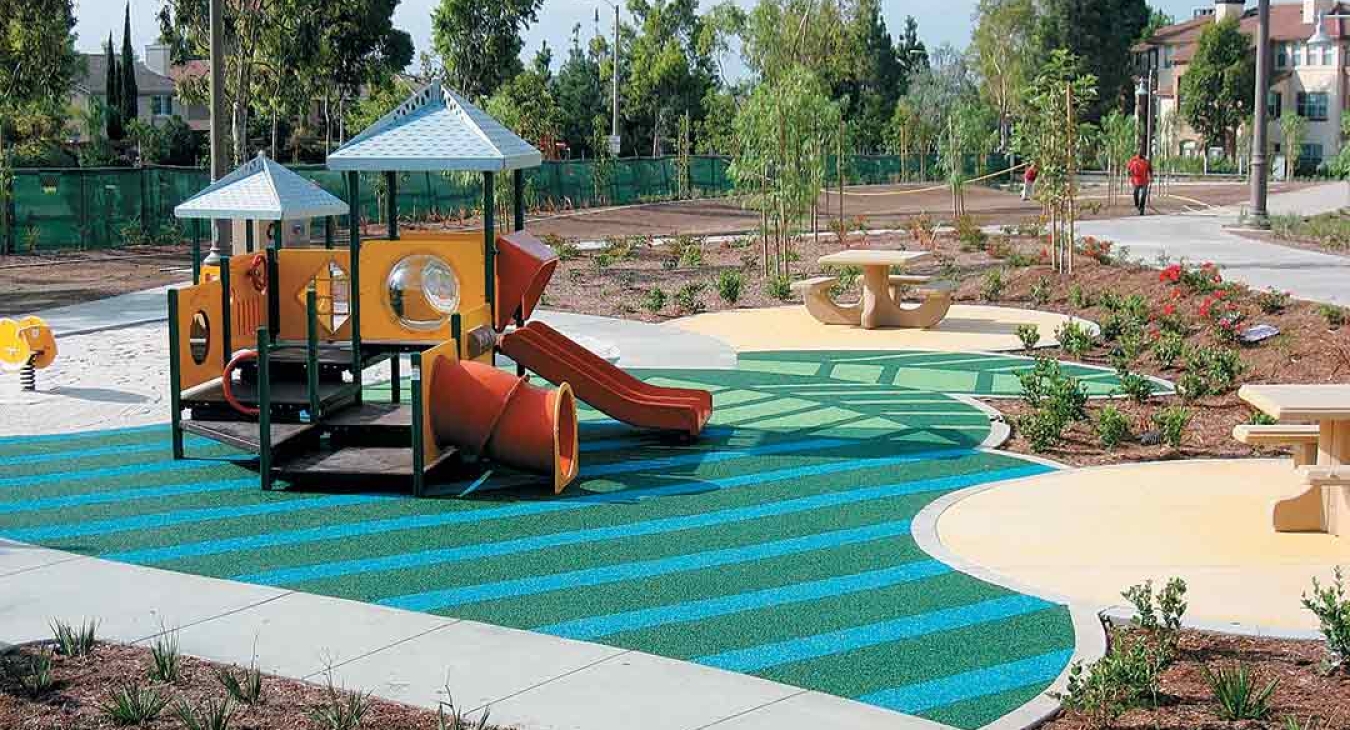
Whether building the Taj Mahal or a backyard shed, the importance of sound construction practices is paramount to a successful project. This same mindset should apply to the installation of a poured-in-place playground surface as well.
Thus, the flow of water on the site, the soundness of the base on which the resilient rubber/urethane mix will be laid, and the perimeter edge detail all need to be considered as part of the plan. The last part of the equation is using proven, high-quality materials and experienced professionals for the installation. When the project is properly planned, the foundation has been laid for the maximum life expectancy of the surface to be realized.
Poured-In-Place Playground Surfacing Drainage
One of the many attractive features of poured-in-place surfacing is that it is very porous, which eliminates puddles and allows children to use the surface immediately after heavy rains and snow melts. This porosity also minimizes slippage because the water flows into the body of the surface and migrates down vertically to the base. Unfortunately, too often this is where the “planning” for water flow ceases.
Proper planning also needs to include what happens to the water after it goes through the surface. The solutions range from drainage outlets at the base level to a porous crushed stone base that allows the water to percolate vertically through the stone. Slopes and weep holes can also be built into the design. The key point is that the site will drain the same way after the surfacing is in place as before and sound construction planning will ensure that water does not simply sit at the bottom of the surface—unseen—and shorten the life of the investment.
Base Construction, Edge Detail
Poured-in-place surfacing is typically laid on asphalt, concrete, or crushed stone. Minimum accepted thicknesses of asphalt and concrete are sufficient for playground applications. As long as drainage considerations are part of the design and one of the standard edge details is chosen, there’s not much else to consider. Bear in mind that the rubber will reflect the levelness of the base on which it is installed.
Crushed stone is very commonly used because of its favorable economics. It is an excellent option, but one that has to be monitored closely. Follow a proven specification that spells out the stone sizes and compaction rate. While it is a less expensive option than concrete and asphalt, crushed stone bases are also much more likely to cause problems that will adversely impact the life of the surface.
These potential problems include sink holes that cause great stress on the rubber surface, undulations that result in a wavy completed job, and inadequate percolation of water through the base. An unacceptably large stone in the top layer of the crushed stone base, which prevents an even, proper distribution of the basemat layer of the poured-in-place surface, is another common problem.
The main function of the surface is to absorb shock and prevent major head trauma from falls. The basemat is the shock attenuating element of the surface, so applying the necessary depth in a consistent layer is fundamental to the design. Meeting the stone specification is therefore necessary, as is containing the entire stone base with a wood or concrete curb border. If the crushed stone base specification is closely followed, it’s an excellent choice as a base.
Material Quality And Specifications
The surface is made from three fundamental components: SBR rubber, EPDM rubber, and urethane. The basemat of the two-layered poured-in-place system combines black rubber strands (SBR) and urethane that’s applied in varying thicknesses determined by the critical fall heights of the playground equipment under and around where it's installed. A healthy percentage of urethane specifically formulated for playground applications, along with right-sized, low-dust-content rubber, will ensure that the basemat is strong and resilient.
The top surface combines EPDM rubber in one of many colors and, again, urethane. The urethane in the top surface is typically formulated a bit differently than what’s used in the basemat, but ultimately serves the same purpose of binding together rubber particles into a monolithic surface. The top layer has a higher percentage of urethane in the mix. In both layers, the rubber serves as the resilient component, while the urethane is the strength of the surface. Be certain that a generous quantity of the top layer mix of EPDM rubber and urethane is applied so that a full, dense layer of the top surface results. This will have a huge impact on how long the surface lasts.
Poured-in-place surfacing must withstand years of exposure to the elements and intense use, including but not limited to ultraviolet rays, moisture, and the pounding and scuffing of children at play. It’s critically important that the quality of these material components is proven and formulated for longevity. Surface America has many installations that are more than 10 years old and some are entering their 19th year of use. We deliver this message from experience.
Installation
The craftsmanship of the crew cannot be overestimated. While all of the points above are very important to extending the life of the surface and maximizing an investment in poured-in-place surfacing, perhaps the single most important aspect of building for success is the crew. This is the case, in part, because they report site conditions and construction plans that need attention before the installation, but also because the poured-in-place installation process requires a healthy dose of “art and science,” along with tenacity.
Planning the install, staging the work, coordinating the installation team, mixing the materials, moving the materials efficiently, working the trowel, laying out the graphics—all while battling both the outdoors and the challenges of construction (heat, moisture levels, other trades, extensive travel, heavy materials, and tight schedules)—make the poured-in-place installation process demanding. These completed jobs are simply amazing, as terrific colors and creative themes are laid into the surface by professional crews. In the end, the crews find it to be very rewarding work.
Maintenance
Fortunately, there’s not much to write about here. Treat your playground surface to an occasional sweeping, blowing, raking, or hosing off. That’s all there is to the maintenance.
In closing, note that a well-planned poured-in-place surface will be around for many, many years. So, sit back and rest assured that if you did the proper planning in the construction phase, the only “work” that remains is getting the kids off the playground when it’s time for their school work.
(ED—Dobmeier is the president and founder of Surface America and sister company A-Turf. For more information, visit www.surfaceamerica.com.)