


Third in a 4-week series on playground surfacing.
WHILE THE COST of surfacing your playground can vary widely depending on what materials your city, school, or community decides to use, they all have one thing in common: they cost money.
So you want to protect your investment and get the absolute most life out of it that you can. That requires picking the right surface for your playground, proper planning and design, proper installation, and long-term maintenance.
We chose four of the most popular playground surfaces—poured-in-place, tiles, rubber mulch, and engineered wood fiber—used today and asked experts in each of these fields of playground surfacing to give their advice on the important steps of installing and maintaining the surface.
Next week: Engineered Wood Fiber by Bob Zeager
Swinging, climbing, sliding, and running. These are all favorite playground activities that are meant for fun and fitness. However, these activities can also result in serious injuries if a child falls on a playground surface that was not properly built or well-maintained.
The U.S. Consumer Product Safety Commission (CPSC) reports that more than 150,000 children are injured each year as a result of playground falls. Given this statistic, surfacing material must be soft enough to cushion a child’s fall, while also being durable, long-lasting, and low-maintenance.
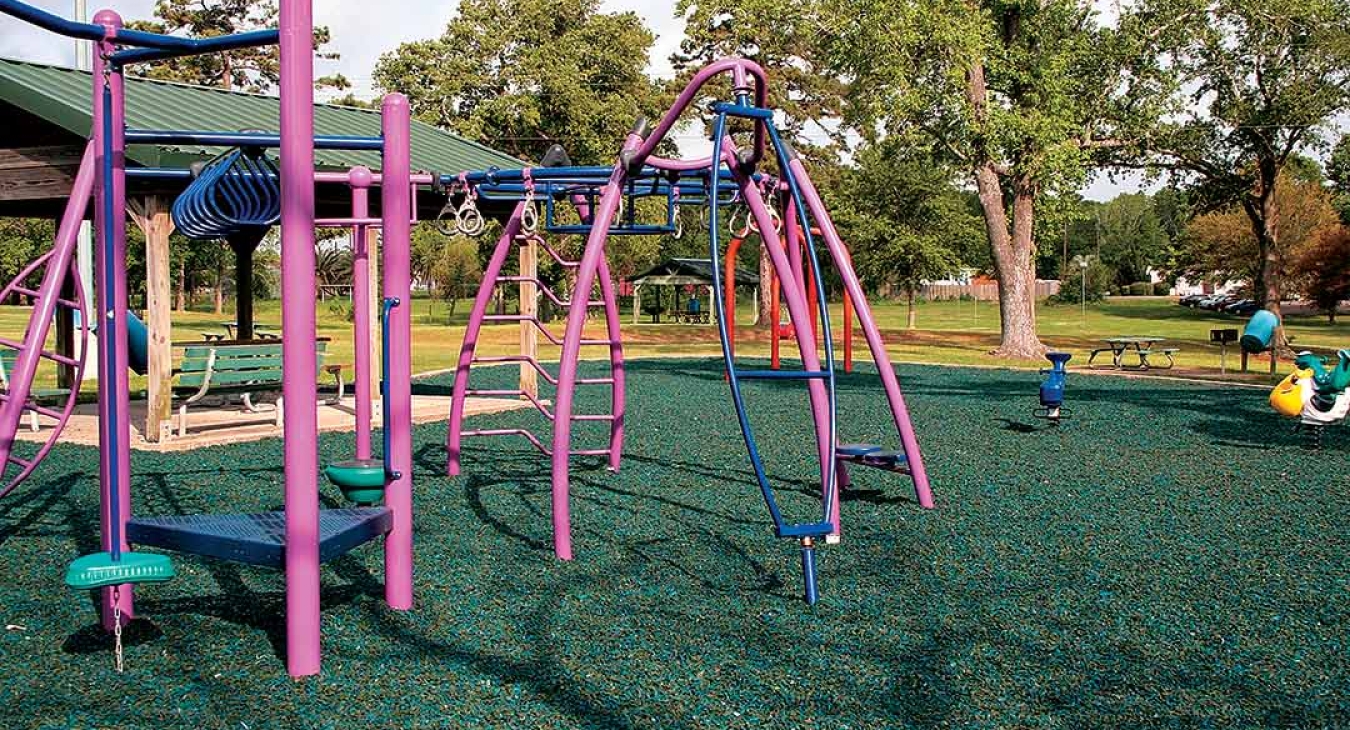
The attributes of recycled rubber mulch directly align with these requirements, and rubber mulch is often considered a safer and more eco-friendly alternative to wood mulch when used as playground safety surfacing. Additionally, with proper installation and ongoing maintenance, rubber mulch will provide consistent aesthetics and performance for years, unlike the annual reapplication that is required with wood mulch.
Rubber mulch requires little maintenance, which offers another reason why it is an ideal playground safety surfacing product. In fact, a few simple tips are all that is required to ensure that rubber mulch remains attractive and, most importantly, is always there to protect kids on the playground when they need it the most.
A Good Foundation
Guaranteeing that rubber mulch performs at its optimal level starts with proper installation. A landscape architect or certified engineer involved in the playground design and planning process should be consulted regarding the topography of the installation area to help ensure proper drainage and prevent water from accumulating in the play area. The area where rubber mulch will be installed must be graded for proper drainage with a substrate that is compacted to provide a firm, even base. Compacted stone is commonly used as a base that allows for drainage. Prior to installing rubber mulch, all pebbles, roots, wood chips, vegetation, and other debris should be removed from the playground area.
A fresh start is recommended for renovation projects, meaning that any previously used material should be completely removed before installation. If left on the ground and then covered with rubber mulch, old materials may rot or breed insects. Additionally, old surface materials may reduce the fall protection of rubber mulch by making their way to the surface and mixing with the new material. Once removed, a layer of crushed stone may be needed to match the access on/access off points of the playground equipment.
For example, if 10 inches of wood mulch were removed, a four-inch layer of crushed stone may be needed below the new 6-inch layer of rubber mulch to ensure the steps and access points of the equipment are at the proper height.
Next, a layer of quality contractor-grade geotextile landscape fabric should be applied to the play area to help combat weed and plant growth and guarantee minimal maintenance down the road. Unlike plastic sheeting, a fabric barrier will allow rainwater to drain away quickly. It will also provide a barrier between the soil and the rubber mulch. The seams of the fabric barrier should be overlapped by a minimum of 3 inches, and all seams need to be properly secured to prevent dirt or other substrate material from mixing with the safety surfacing. Additionally, the landscape fabric needs to be properly secured at the perimeter and around all installed equipment posts or poles. If stone or other material is used as part of a drainage system, then the use of landscape fabric is also recommended in order to ensure that the materials do not mix.
If rubber mulch will be installed above grade, use of a retaining system is highly recommended to reduce migration of the rubber mulch outside of the designated area and to help maintain a level, compacted play area.
Follow The Rule Of Six
After the area is prepared, the rubber mulch should be installed at a uniform level throughout the playground. Any variety of methods can be used for spreading the mulch, including blowing, shoveling, and raking. Care should be taken not to disturb the substrate material and/or the landscape fabric.
When installing rubber mulch, the “rule of six” should be applied. This means that the surface beneath playground equipment should be covered at least 6 inches deep with recycled rubber mulch extending at least 6 feet in all directions surrounding the equipment. This is extremely important for playground surfacing. When properly maintained at a 6-inch depth, the ASTM F1292 test indicates rubber mulch will provide up to 16 feet of critical fall-height protection.
A good tip to help ensure that the mulch is being installed at the proper amount is to measure 6 inches from the base and draw a line on the playground equipment posts with paint or permanent marker. As material will inevitably be displaced in the high-use zones, an additional two to four inches of rubber mulch should be installed in these areas.
Low Maintenance, High Performance
Even with a good, safe foundation in place, proper playground maintenance is a critical issue. Poor maintenance practices can increase the possibility of injuries on the playground. One of the benefits of rubber mulch as a safety surface is that it needs very little maintenance. In fact, in most environments and with proper maintenance, rubber mulch will provide consistent performance, as well as remain attractive, for at least 12 years.
However, a few simple tips can help get the maximum life out of rubber mulch and guarantee its effectiveness as a playground safety surfacing:
- In order to provide consistent head impact protection and accessibility of the playground, a level, compacted 6-inch depth of rubber mulch must be maintained. Upon discovery of a thin, un-compacted, or non-level condition, the surface of the playground area must be raked and compacted to ensure consistent and proper installed depths.
- Periodic replenishment may be required if rubber mulch migrates outside of the play area, cannot be reclaimed, and a level compact depth for the required fall height protection cannot be achieved.
- To maintain the appearance of rubber mulch, a leaf blower can be used to remove loose debris such as leaves and twigs. Because rubber mulch does not absorb water, a hose can also be used to wash off any dirt or mud.
Rubber mulch makes smart safety sense and requires much less sweat equity in terms of maintenance. A small amount of maintenance yields excellent performance year after year, making rubber mulch an ideal safety surfacing solution for playgrounds. When considering the yearly costs associated with replacing wood mulch, rubber mulch costs 65 percent less over five years. As cities and municipalities grapple with dwindling budgeting resources, recycled rubber mulch offers a viable alternative for playground safety surfacing.