

Sustainability and Injury Prevention - Strategies, Specifications, and Warranties
Providing a playground for children is a positive event for them and their community. Play is critical to a child’s personal and social development. Through play, children learn to take on challenges and overcome fear by learning about themselves and negotiating for assistance from their peers. This is not only important in the moment, but the achievements on the playground are carried throughout a lifetime. Adults who wonder how they grapple with mundane, but complicated tasks must only look back to their childhood and play for the answer.
Playground designers are privileged to design a playground and define the play for the children using it. They hold considerable sway over how play will be approached, but can also sometimes be surprised by how children interpret the options presented to them and their reasonably foreseeable use. This involves choices about which play structures are used or whether the surfacing materials and landforms can be formed in a playful way to allow for play value and flow. They may very well shape the development of a child in a significant way.
For the licensed professional, Architect, Landscape Architect, or Engineer, there are specific obligations that should apply to everyone concerned with the playground, but have significance to the professional. These obligations include injury reduction and prevention through the protection of public health and safety, financial and functional longevity for their design by choosing sustainable products and practices. Unfortunately, not every product and/or material provides functional longevity, and more importantly, trusting that the CSA Z614, ASTM F1487, ASTM F1292, or the CPSC Handbook meets society's tolerable injury severity can place the profession at risk. Just as important is the provision of inclusion and accessibility within the play space.
Injury Prevention
Injury prevention is a difficult topic as it requires the design group to consider the severity of injury that is tolerable and the likelihood of it occurring. We must remember that approximately 75% of all injuries in playgrounds are falls to the surface, and the younger the child, the more likely they are to land on their heads due to a higher centre of gravity.
Injury prevention is never an easy discussion; however, it matters to the end user and the owner/operator of the playground. The Licensed Professional is the gatekeeper for those interests. Sadly, the minimum performance in standards will rarely accommodate those professional obligations. For CSA Z614, the aim is to prevent serious and life-threatening injuries, with ASTM F1487, the aim is to prevent life-threatening and debilitating injury, while ASTM F1292 sets the limits for impact attenuation at ≤200g and ≤1000 Head Injury Criteria (HIC). These are problematic when the US Consumer Product Safety Improvement Act requires the prevention of serious injury. Additionally, the Canadian Consumer Product Safety Act specifically requires prevention of hazards with an acute or chronic affect. Lastly, there is the automotive data and vehicular requirements setting the impact attenuation performance that makes children currently better protected when driving to the playground than when at the playground.
Both the CSA Z614 and ASTM F1487 stipulate that the minimum performance for the playground protective surfacing is to ASTM F1292, which sets the maximum g to 200 and the maximum HIC to 1000 for the life of the project from the equipment fall height. Let’s consider the injury severity and risk of that injury at the limits of ASTM F1292 through the following graphs.
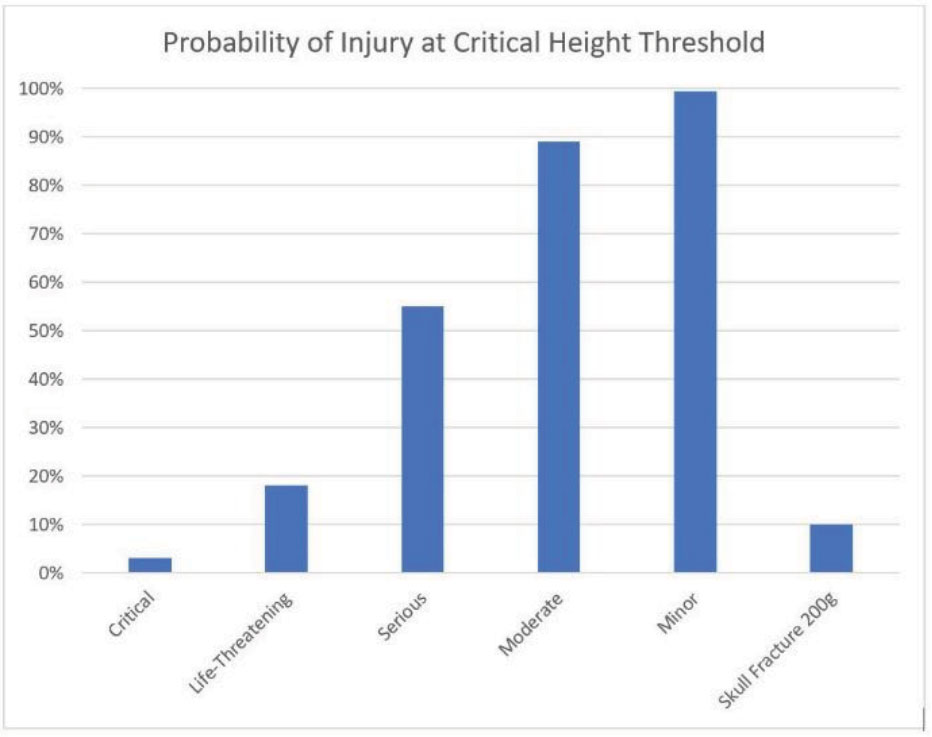
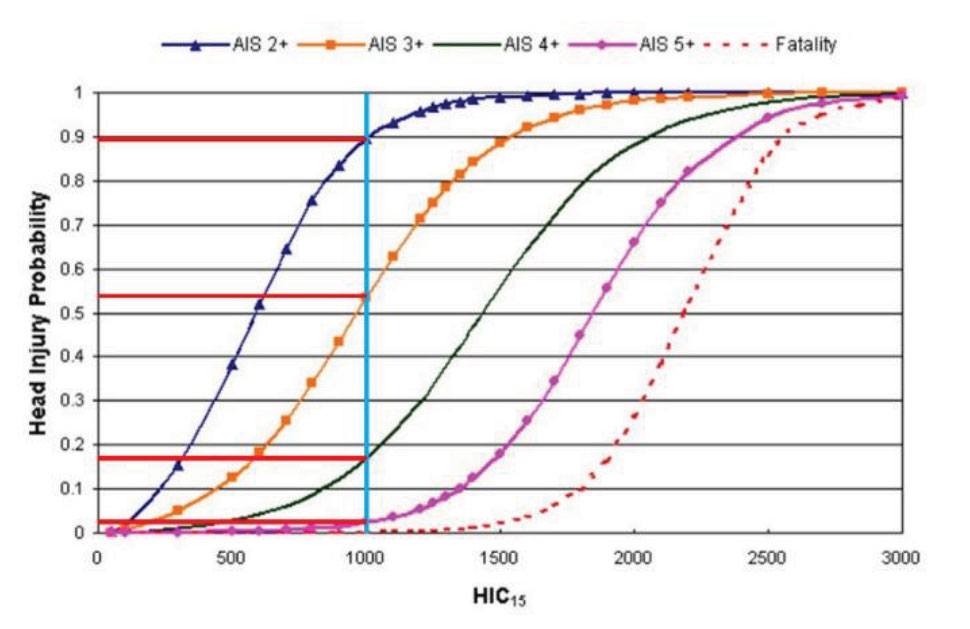
Should the limit of ASTM F1292 be adopted for the minimal fall height, these are the risks of each associated severity of injury to occur. Additionally, the bar chart shows that a value of 200g is a 10% risk of skull fracture. Selecting compliance with CSA Z614 or ASTM F1487 adopts these values. These are not the values that society will deem tolerable, and therefore, playground owner/operators, designers, and manufacturers are sued regularly when lesser injuries occur.
The impact values and associated injury severity have been developed over more than 60 years of research, and in the year 2000, legislation in Canada and the United States stipulated performance for all passenger vehicles for HIC. The National Highway Traffic Safety Administration, in its final rule for vehicle restraints in 1999, set the following;
Dummy type/limit | Large Male | Mid-sized Male | Small Female | 6 year old child | 3 year old child | 1year old infant |
|---|---|---|---|---|---|---|
HIC15 limit | 700 | 700 | 700 | 700 | 570 | 390 |
As it turns out, playgrounds fit nicely into this table, with playgrounds being categorized for children under 2 groups: 18 months to 5 years (CSA Z614), 2 to 5 years (ASTM F1487), and 5 to 12 years. As a result, these values can be adopted for lifetime values in the playground, providing a different HIC graph at 700 HIC for the 5 to 12 year group, eliminating critical and reducing the life-threatening to <4% and the serious to 25%. A similar change can be adopted for the under-5-year and under-2 play structures and spaces. This is particularly valid in the development of a child care centre.
A further complication is that nothing gets better with time, particularly when the project is to have a minimum life of 20 to 25 years. As a result, the values at the time of installation must reflect the proven and demonstrated performance over 20 to 25 years. This may include maintenance and repair procedures that affect the product's functional longevity. The ASTM F3313 Test Method for determining impact attenuation of installed surfaces can help by allowing the specifier, before purchase, to specify both lower values for g and HIC and stipulate higher drop heights for testing and compliance than the stated equipment fall height.
At this stage, we have the recommendation that the surfacing system being selected have a demonstrated functional life of 25 years and the HIC values for playground for children under 2 years at <390 HIC, for 2 to 5 years at <570 HIC, and 5 to 12 years at <700HIC for the life of the playground minimally from the stated equipment fall height. A higher height for drop testing is recommended.
Fiduciary Product Oversight
Every licensed professional has an obligation to consider the financial burden that their selections could place on a project or owner. Depending upon the type of surface system selected, there could be a low capital cost, with high maintenance costs, or a high capital cost, with low maintenance cost, or a high capital cost with repeated high cost of repair or replacement. This is particularly the perceived choice between Engineer Wood Fiber (EWF) and Poured-In-Place (PIP) surfacing. EWF has a generally low initial cost, even if installed properly with vibratory compaction, and will require frequent inspection and maintenance, particularly in high-traffic areas and where accessibility compliance is essential. A bonus of EWF is that when installed and maintained to a 300mm (12”) depth, this system can provide exceptional g and HIC values for drop testing; however, it has difficulty maintaining accessibility. Synthetic surfaces, such as PIP, are the highest capital cost system that can be added to a project.
Generally, they are adopted for the ability to create designs for top-down viewing and the ease with which persons with disabilities are able to traverse the surface. What is forgotten is that due to cost, these surfaces are generally installed to g and/or HIC limits of the ASTM F1292 and generally fail to perform to that standard after 5 years. Traditionally, the polyurethane binder that is used, an aromatic MDI, has great strength of bond, but loses elasticity and therefore impact attenuation due to UV exposure. Failure is inevitable. Alternative UV-resistant binders with proven longevity are available at additional cost. This complicates good fiduciary oversight.
Accessibility and Inclusion
Almost every playground today is intended to be completely or partially accessible. Accessibility means the removal of architectural barriers and bringing everyone to the activity. Inclusion is broader, considering play value, gender, age, culture, and other societal factors that might affect a person's ability to participate.
Playground surfacing systems can improve inclusion; however, they have a lot to do with accessibility. The US DOJ 2010 Standards on Accessible Design are the core to accessibility, with CSA Z614, Annex H being a Canadian derivative. These contain very mechanical performance measures that are easy to determine and hard to achieve.
The first thing to remember is that accessibility is ageless. That means, beyond children, the person who has the disability could be a caregiver bringing children to a playground and needing the ability to provide active supervision. They could be visually impaired, need a mobility device, or another aid to traverse the playground. Your choice is how many play components are accessible with Section 240 of the ADA or Table H.1 of Z614 providing the minimum numbers of elevated and ground-level play components that must be accessible. Once the play components are established, the ground-level accessible route (GLAR) can be laid out. The GLAR must start at the entrance to the play space, connect all the accessible play components, and return to an exit. This could be a single route or multiple routes through a loose fill material that is firm and stable, or the total area, such as when a synthetic surface is used in the entire play space. The GLAR has very specific and measurable performance requirements. These must be in place at the time of installation and throughout the life of the project.
GLAR surface requirements.
- Surface must be firm and stable in compliance with ASTM F1951. It is important that the professional read and understand how the test sample was installed to successfully pass the test and ensure that the same techniques are used at the time of installation in the playground. Ongoing testing can be performed using the Instrument Surface Indenter, which allows for confirmation of the firmness and stability of the installed surface.
- It is generally 60” (1525mm) wide; there are a few exceptions for areas under 1000 ft2 (93M2)
- Surface must have a running slope not exceeding 1:16 (6.25%)
- Surface must have a cross slope not exceeding 1:50 (2%)
- Surface must have no openings that allow for the insertion of a ½” (12.7mm) sphere
- Surface must not have, for the ADA, a change in vertical height greater than ¼” with a second ¼” being permissible provided it is on a 1:2 slope, while for Annex H with maximum initial change in vertical height is ½” (12.7mm) with a second ½” (12.7mm) being on a 1:2 slope.
- There shall be a transfer at each transfer onto the play structures and transfers from accessible play components within the playground measuring 60” x 60” (1525mm x 1525mm) in each direction and having a slope no greater than 2% in all directions.
- If a carpet (synthetic turf) is used, the pile height shall not exceed ½” (12.7mm)
- The surface must be impact attenuating at a minimum to ASTM F1292 (≤200g and/or ≤1000 HIC from the equipment fall height)
Ultimately, accessibility is the minimum, with inclusion being the goal. Providing play value for all, washrooms, change areas, benches, picnic tables, etc., are all features that elevate inclusion.
Sustainability
Over the years, many terms such as recycled, recyclable, consideration of climate change, functional longevity, low carbon footprint, etc., have gained prominence in the planning, implementation, maintenance, and end-of-life of projects. It is no longer acceptable to consider a product, service, or facility that does not combine all of these into sustainability. This will also apply to the playground protective surfacing system.
Effectively, sustainability provides the maximum benefit and the least amount of harm to the environment in which the product, service, or facility are established. Playground surface systems are complicated when it comes to sustainability. EWF and PIP are recycled; the first is wood, while the second is mostly tires.
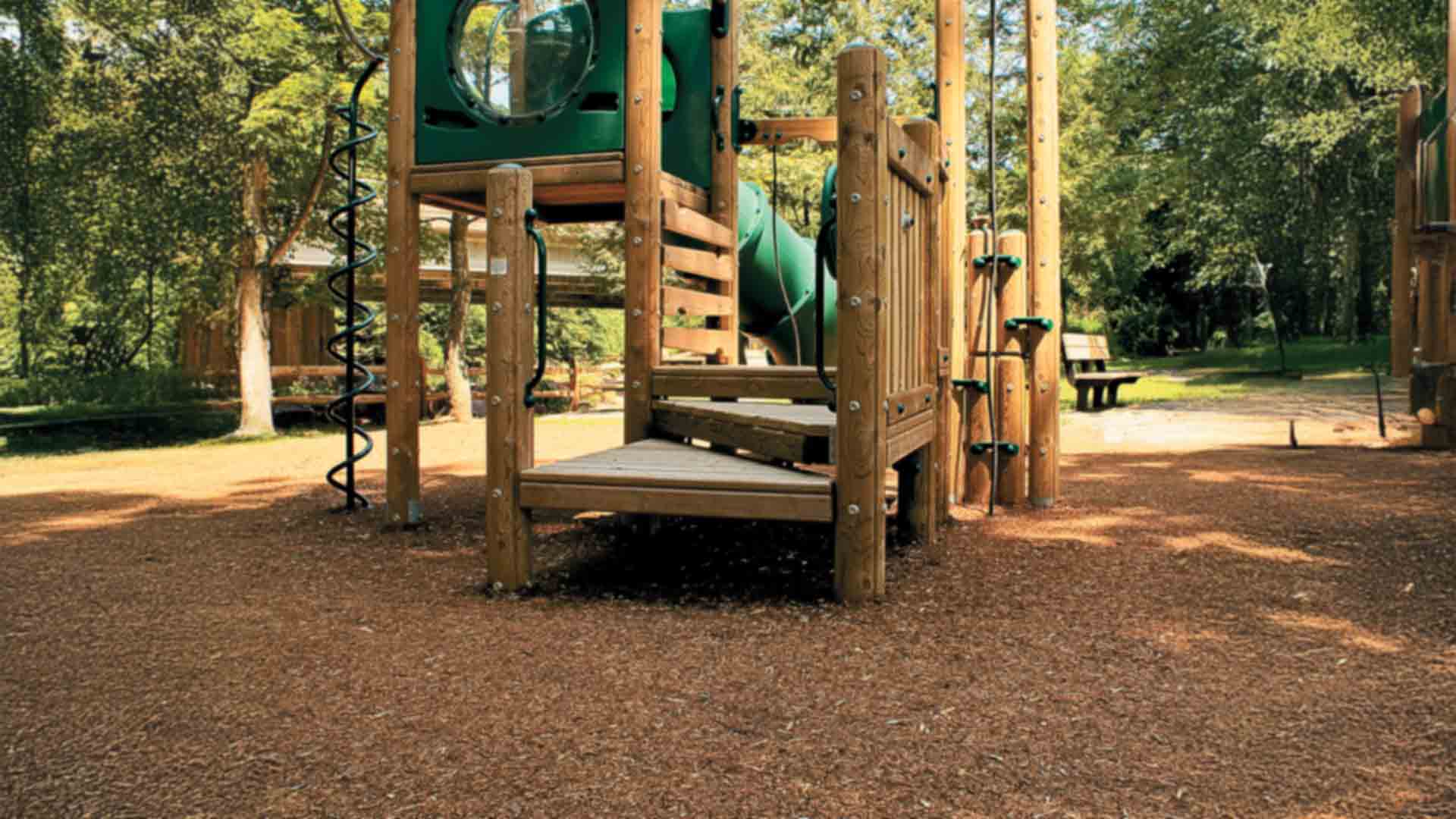
EWF was traditionally offcuts from the logging process, giving a waste product a second life. They are organic and will decompose with time, necessitating topping up every few years. EWF must be installed in two 8” (200mm) lifts and compacted with a vibratory roller or tamper between layers, causing the fibers to knit. Failure to do so or allow the EWF to settle naturally will result in a surface that is undulated and does not come close to the accessibility requirements. In high traffic areas, many suppliers provide rubber mats that must be installed at the top of the surface to ensure that this transition area is < 2% slope in all directions and allows people to navigate the surface without impediment.
Maintenance of EWF will entail regular inspections and leveling to ensure the performance measures are met. The surface should never be rototilled as with sand or pea gravel, as this will aerate the EWF and promote composting. When the surface does naturally compress, it will require topping up, which should be with EWF from the same supplier and at a minimum EWF that meets ASTM F2075. Prior to adding more material, the existing surface should be roughened and then leveled, knit together using the vibratory roller or tamper.
Over the 20-to-25-year life of the playground, this system can have a significant total cost when both the initial installation and ongoing maintenance and topping up are considered. Unfortunately, many playground owners do not provide the degree of maintenance needed, thinking they are saving costs. This cost-saving is at the expense of leaving a whole sector of the community without access to play. An incentive and saving grace is that well maintained EWF will have exceptional impact attenuation and injury prevention values. Ultimately, at the end of life, the decomposed EWF can be transferred to community gardens as a recyclable material.
PIP rubber is also substantially recycled, with the lower cushion and mid layers composed of recycled tires cut into small fibers called buffing or rubber crumbs. PIP turns a difficult waste product into a durable and useful raw material. The top wear layer can be recycled rubber, but where colour is required, it will be a new EPDM rubber crumb or TPV particle. Polyurethane binder is used throughout the system to ensure the rubber particles remain in place throughout the years and not be affected by traffic across the surface. Holding the particles in place is more difficult on slopes than on the flat, making the installation of impact attenuating PIP on or around hills and mounds difficult. At the time of installation, these PIP surfaces are attractive and easily accessible with all manner of mobility devices and aids. Unfortunately, that does not cover the potential downsides that must be considered and allowed for in the project specifications.
Although PIP can provide durability and a traversable surface, the difficulty is providing adequate impact attenuation, particularly as children climb higher and higher, placing themselves at greater risk of injury. Many surfaces are specified and installed to provide g ≤200 and/or HIC ≤1000 and a one-year construction warranty. This is exacerbated by exposure to UV making the surface brittle and harder. In areas like Singapore, 1.35 degrees from the equator, these surfaces fail in as little as 3 to 5 years. As we move through North America, the intensity of UV is less, but the failures are 5 to 9 years. Once the surface fails, it places children in extreme danger, the owner/operator in a position of gross negligence, and a financial quandary of where to find the funds for replacement, only 40% into the life of the playground. This is a sustainability problem with the original surface going to landfill at least twice before the playground in total reaches the end of life and planned replacement.
Some other problems with PIP are shrinking, gaps, granulation, foaming, and swelling. All of these are roots of failure.
- Cracks that allow the insertion of a quarter that appear in the surface are caused when there is a significant change of temperature, likely overnight, during the cure time. These cracks appear when the surface shrinks, generally in the cold, and disappear when the surface expands, when the surface warms up. When these cracks are open they offer an entrance to inquisitive hands to dismantle the surface.
- Gaps are ½” (12.7mm) openings that generally appear at seams, colour changes or at the perimeter of the PIP and the outside interface. Once the gap is ½” (12.7mm) the surface fails the performance requirements for accessibility. Almost more important is that small particulate will enter the gap, become hard and an impact hazard should a child fall onto that part of the PIP.
- Granulation is a persistent failure that only goes away once the surface is worn through. Although PIP is known as rubber, the quality and quantity of the binder is important.
- Saving money and cutting the binder will lead to granulation.
- Rain during or immediately after installation will wash the binder down, leaving too little binder to hold the surface together.
- In the autumn, installers take risks with temperature. As the temperatures drop, the cure time
increases, and the binder can “drain down,” leaving very little binder for durability. - Another failure caused by rain is the binder foaming, leaving the bond between the rubber
particles full of holes like “Swiss cheese”, again causing granulation and failure. - A method for determining whether the bond of the polyurethane binder is sufficient is in the Singapore SS495 Surfacing Standard, the Wing Pendulum Tester.
- Additional information and potential problems can be found in ASTM F2479
- Swelling is a problem that manifests in areas that experience cold snaps and the PIP retains water. This can be in a new installed on an impermeable base, an older surface that has filled with fine particles, plugging the system or a recap where the interfacing surface is cleaned on top to allow for a bond layer on layer, however does not move water through the surface due to contamination that was not removed prior to installation. If the owner/operator is lucky, the swelling will shrink and return to normal, but there may be delamination within the system, bringing on failure. Where the swelling does not recede, the wear layer must be removed, the drainage repaired and at a minimum a new wear course installed.
All these failures before the 20-to-25-year life of the playground result in significantly increased cost, filling landfills unnecessarily, liability for owner/operators, and a total failure of sustainability.
There is one synthetic surface that does need the impact, accessibility, and sustainability requirement, SMARTE. This system was developed under a tire recycling grant. It replaced the binder and rubber in the cushion layer to confine the rubber in a geotextile bag. These bags absorb the impact, and when the playground reaches the end of its life, they are put to the side and reinstalled. Truly recycled.
Playground surfacing sustainability encompasses injury prevention to a societally tolerable level, maintainable features, functionality, and fiduciary responsibility over the 20 to 25 years anticipated life of the project. All other things being equal, time is the great judge of a successful product or project.
Supporting Specifications
In developing a specification, the principles and philosophy of sustainability and functionality should take precedence. This embraces both injury prevention and financial responsibility. Writing a performance-based specification first, a maintenance budget second, and a performance-based warranty will ensure the success of both products and the playground.
Relevant Standards
- ASTM D2859 - Standard Test Method for Ignition Characteristics of Finished Textile Floor Covering Materials
- ASTM E303 - Standard Test Method for Measuring Surface Friction Properties Using the British Pendulum Tester
- ASTM F1292 - Standard Specification for Impact Attenuation of Surfacing Materials Within the Use Zone of Playground Equipment
- ASTM F1951 - Standard Specification for Determination of Accessibility of Surface Systems Under and Around Playground Equipment
- ASTM F2075 - Standard Specification for Engineered Wood Fiber for Use as a Playground Safety Surface Under and Around Playground Equipment
- ASTM F2479 - Standard Guide for Specification, Purchase, Installation and Maintenance of Poured-In-Place Playground Surfacing
- ASTM F3313 - Standard Test Method for Determining Impact Attenuation of Playground Surfaces Within the Use Zone of Playground Equipment as Tested in the Field
- ASTM F3351 - Standard Test Method for Playground Surface Impact Testing in Laboratory at Specified Test Height
- CSA Z614 - Children’s playground equipment and surfacing
- US CPSC - Public Playground Safety Handbook (doc 325) (revised 2025)
The current standards are used unless otherwise noted.
Prequalification
Prospective contractors must have been in business under the same corporate name, manufacturing and installing the proposed playground surfacing system for a minimum of 10 years.
Be able to provide impact test results to ASTM F3313 indicating that the playground system, after being installed for 10 years, meets or exceeds g <200 and HIC <1000 (lower values for both) for a project with a drop height 500mm higher than the current project.
Provide test reports for three temperature test method ASTM F3351 from drop heights of 14’ (4.25M), 16’ (4.9M), and 18’ ( 5.5M), and the g shall not exceed 100, and the HIC shall not exceed 700 at any height. Test reports shall indicate depth and a top-down and side-view picture of the tested surface.
For EWF, provide a test report for both the straight propulsion and turning tests of ASTM F1951. The report shall include the depth of the surface tested and the installation methods used in preparation of the sample for testing.
For EWF, provide a test report for compliance to ASTM F2075.
Site Installation Specification
The base shall be compacted to 95% spd and well-draining.
A geotextile separation shall be placed between the base material and the lowest layer of the playground surfacing system.
The installed system will be tested in the field using Test Method ASTM F3313 with a drop height of a minimum of 38” (960mm) above the fall height of the associated structures and no value shall be greater than 100g or 700 HIC for structures intended for children 5 to 12 years, 570 HIC for structures intended for children 2-5 years, and 390 HIC for structures intended for children under 2 years of age.
At any hard surface interface between the playground surfacing and the perimeter of the playground, there shall be a notch in the hard surface, and a PIP surfacing system shall be installed on to the notch to prevent settlement, sinkage, or gapping.
The installed surface must meet the following performance for accessibility;
Be firm and stable when tested with an instrumented surface indenter
Have no change in vertical height greater than ½” (12.7mm) with the first ¼” (6.4mm) begin vertical and the second ¼" (6.4mm) being on a slope not greater than 1:2 for installations under the ADA and no change in vertical height greater than 1” (25mm) with the first ½” (12.7mm) begin vertical and the second ½" (12.7mm) being on a slope not greater than 1:2 for installations under the CSA Z614, Annex H.
- Have no gaps that allow the insertion of a ½” (12.7mm) sphere
- Have a running slope in the path of travel that does not exceed 1:16 (6.25%)
- Have a cross slope along the path of travel that does not exceed 1:50 (2%)
- Have transition zones at each elevated play component that comes to the ground or at each ground level play component that is a minimum of 60” (1525mm) in all directions and with a slope less than 1:50 (2%) in all directions
If the surface system to be installed is EWF, the installation shall be in a minimum of 2 lifts of 8” each, and each lift shall be wetted and compacted with a vibratory roller or plate tamper to meet the above accessibility requirements. Alternatively, the installation procedure in the field shall follow the written instructions provided by the supplier to the test laboratory for the ASTM F1951 testing.
Where wear mats are installed, they shall be level with the surrounding surfacing materials.
Where the wear mats are installed with anchors, there shall not be sharp materials exposed to children
Maintenance Instructions
The supplier of the PIP shall provide detailed maintenance and repair instructions that allow the owner/operator to preserve the performance of the surface system. Included shall be;
- Frequency of inspection for maintenance
- Type and frequency of maintenance or cleaning, including standard surface cleaning practices that are not to be used.
- Instructions for cleaning for the removal and prevention of small particles entering and remaining in or on the surface. Cleaning techniques that must be commented on are:
- Sweeping
- Blowing
- Vacuuming
- Pressure Washing
- Maintenance procedures or cautions should the playground surface be submerged or become inundated with standing water.
- Should there be damage to the surface system, either by vandalism or normal wear and tear, provide the procedure to prevent further damage and a detailed procedure for the repair, including the layering to emulate the impact attenuation of the original surface.
- Provide any requirements for the application of coatings or other protective materials required to prevent damage from UV or rejuvenate the system. This shall include a current budget estimate for the required work.
The supplier of EWF shall provide the detailed maintenance and rejuvenation procedures for the systems installed. If wear mats are provided as part of the installation, they shall be included in the instructions.
- Frequency of inspection for maintenance
- Steps to be taken when seasonal cold and frost can render the EWF frozen. Methods of determining a frozen condition, and/or methods of thawing the surface for playground operation and use by children.
- Type and frequency of maintenance, cleaning, leveling, or replacing EWF, and repositioning of wear mats where required.
- Frequency of topping up and the method of surface preparation, and the installation of the additional materials.
- Provide a current budget estimate for annual maintenance to maintain the accessibility performance.
- Provide a current budget estimate for the topping up as the EWF settles.
Warranty
The warranty shall be for a minimum period of 5 years. A longer warranty period is acceptable, provided the terms of the warranted performance do not diminish the performance within the 5-year warranty period.
At the time of installation and throughout warranty period the surface shall be tested for impact attenuation, using test method ASTM F3313 at a drop height 38”(960mm) above the fall height for composite and free standing structures, the pivot point for swings, the reasonably achievable height for children using unique play components and 38” (960mm) above the surface with the structure is considered to have no fall height. No value for g shall exceed 100, and no value for HIC shall exceed 700 HIC for structures intended for children 5 to 12 years, 570 HIC for structures intended for children 2-5 years, and 390 HIC for structures designed for children under 2 years of age.
The surface shall meet the accessibility requirements as stated in the specifications for the entire warranty period.
The warranty shall be with the immediate contractor, be they a general contractor or installer of the system, and include the manufacturer of the system(s) as well as the installer of the system(s). The warranty shall include contact information for each party to the warranty and the method of contact. The warranty can provide for a first contact to facilitate service.
The warranty shall state that once contact has been made by the owner/operator of the playground surfacing system the amount of time the primary contact has to respond to the receipt of notice, how much time to visit the site and confirm a warrantable circumstance has taken place and once the decision is made to repair the system, actually performing the repair, weather conditions permitting in a timely fashion.
Conclusions
A successful playground project is one where all components, structures, and surfacing continue to function as specified and intended for the anticipated life, which today is 20 to 25 years. Play components can be replaced individually, while surfacing failures generally require wholesale removal and replacement. This is costly. Through effective performance specifications, quality maintenance, and a well-crafted warranty, a project can have assurance of meeting the goals of sustainability, including injury prevention and functional longevity.
All playground stakeholders have a role to play. The greater degree of responsibility and therefore liability is with the Licensed Landscape Architect or Engineer, where their licensing obligations require protection of public health and safety and a fiduciary relationship to their clients.